US economic sanctions policy confronts diminishing effectiveness as targeted states develop adaptive strategies, prompting Washington’s escalation from financial pressure to physical asset seizure. Trump’s December 2025 Venezuela oil blockade, involving Coast Guard seizures of tankers carrying nearly 4 million barrels and 15,000 US troops deployed regionally, exemplifies this transition. However, Venezuelan crude exports reached 784,000 barrels daily in November—surpassing 2025 averages—with China absorbing 613,000 bpd while even the United States imported 150,000 bpd under General License exemptions for Chevron.
Atlantic Council’s sanctions tracker documents 209 Venezuela-linked individuals sanctioned by Washington, 123 by Canada, and 69 by the EU as of March 2025. Yet Chatham House analysis emphasizes these extensive measures “failed to spark improvements in human rights or significantly weaken the regime,” while unintended effects include “punitive consequences for ordinary citizens and increased concentration of economic and political power among the regime’s domestic allies.”
Adaptation Strategies Undermine Coercive Objectives
States subjected to comprehensive sanctions have developed sophisticated evasion mechanisms rather than submitting to Washington’s demands. Venezuela rerouted oil exports to alternative markets, shifted payment channels away from US-dominated financial systems, and deepened partnerships with Russia, Iran, and China. Foundation for Defense of Democracies reporting indicates Venezuela’s heavy crude export capacity depends on Russian naphtha imports (419,000 barrels in November), illustrating strategic interdependence among sanctioned states.
Atlantic Council’s Energy Sanctions Dashboard documents Russia, Iran, and Venezuela employ similar evasion tactics: shadow fleet tankers, ship-to-ship transfers for sanctioned cargoes, and re-exporting through third countries. China emerged as the primary destination for crude from all three heavily sanctioned producers, providing critical economic lifelines. However, this overreliance created vulnerabilities—Russia’s oil and gas revenues fell 20.5% in 2025’s first nine months when Chinese crude demand plateaued.
Government Accountability Office assessments indicate federal agencies do not conduct comprehensive evaluations measuring sanctions effectiveness in achieving foreign policy goals. Challenges include isolating sanctions effects from other factors, shifting policy objectives, and unreliable data. “Russia’s economy declined after invasion and sanctions in 2022 but recovered somewhat afterward,” GAO noted, while “export restrictions hindered but not completely prevented Russia from obtaining technologies critical to its war effort.”
European Paralysis and Asset Seizure Hesitation
Europe’s inability to convert frozen assets into strategic advantage illustrates structural limitations constraining coercive escalation. Despite immobilizing over $300 billion in Russian central bank assets following Ukraine’s invasion, the EU has failed executing outright seizure. This hesitation reflects not insufficient will but systemic fears: full seizure would undermine legal foundations of Western financial systems, triggering capital flight risks, reciprocal retaliation, and eroding trust in European jurisdictions as neutral wealth custodians.
European policymakers resorted to half-measures including redirecting interest generated while leaving principal untouched—a paralysis revealing that escalation does not automatically restore leverage when sanctions lose coercive effect. The inability converting freeze to seizure reflects deeper crisis: sanctions regimes can immobilize assets yet cannot safely convert economic pressure into strategic resolution without destabilizing the order they purportedly protect.
Institutional Targeting and Diminishing Returns
As state-level sanctions stall, coercive pressure widens to ensnare institutions. Washington imposed sanctions on International Criminal Court officials after investigations potentially implicating US or allied personnel in war crimes. Earlier in 2025, sanctions targeted French judge Nicolas Guillou, who characterized being “effectively blacklisted by much of the world’s banking system.”
However, such tactics encounter active defiance. A growing Global South bloc rallies behind targeted institutions, offering financial workarounds and political solidarity. Congressional Research Service reporting indicates Trump administration designated Venezuela-linked criminal groups as terrorist organizations subject to sanctions and military action since February 2025, yet the State Department designated the Venezuelan government itself as a Foreign Terrorist Organization in November—an unprecedented move blurring distinctions between state sovereignty and organizational terrorism.
China’s Strategic Position and Regional Implications
ABC News analysis emphasizes Venezuela, Russia, and Iran “share that sanctioned fleet,” with a full quarter of China’s oil imports produced by these sanctioned countries. Sanctioned tankers represent less than one-fifth of Venezuelan oil exports, yet “[this] can have outsized effects including whether and for how long Maduro can hold out and also with regard to Venezuela’s biggest oil customer, which is China.”
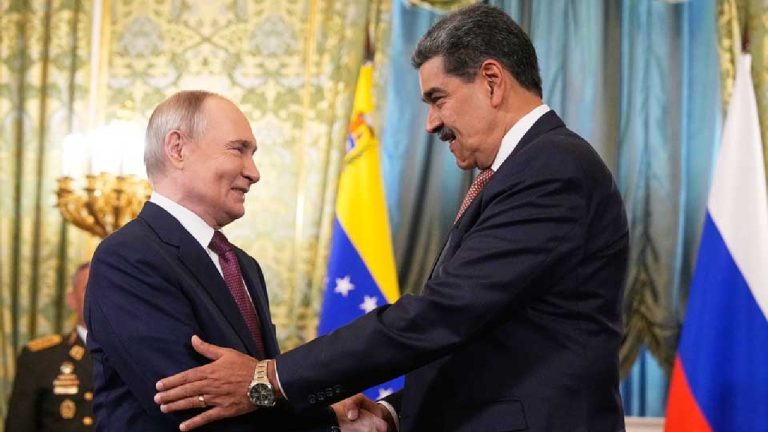
Trump’s December announcement prompted sharp Russian and Chinese rebukes. Moscow “reaffirmed its full support for and solidarity with Venezuelan leadership and people,” while Foreign Minister Sergei Lavrov expressed “deep concern” over Caribbean operations, warning of consequences for regional stability and international shipping. Venezuela requested a UN Security Council meeting backed by Russia and China to address the crisis.
Chatham House observes countries subjected to extensive US sanctions—North Korea, China, Russia, Venezuela, Iran—”have not only survived but also tightened their economic, diplomatic and military cooperation to evade sanctions and develop their own financial and commercial channels.” This pattern accelerated under Biden administration, which added over 7,000 sanctions while maintaining Trump-era measures, increasing total US sanctions tenfold from 912 in 2000 to over 16,000 by 2025.
Documented Humanitarian Devastation
UN Special Rapporteur Alena Douhan’s 2021 assessment concluded that sectoral sanctions had a “devastating impact” on Venezuela’s population, with “humanitarian exemptions” proving largely ineffective due to “overcompliance” phenomena. The report found sanctions “exacerbated pre-existing economic and humanitarian situations by preventing earning of revenues and use of resources to develop and maintain infrastructure and for social support programs.”
UN High Commissioner for Human Rights Volker Türk stated in 2023 that “sectoral sanctions imposed since August 2017 have exacerbated the economic crisis and hindered human rights,” noting he “heard from across the spectrum of people including humanitarian actors and UN agencies about the impact on the most vulnerable segments of the population.” UN Special Rapporteur on the right to food Michael Fakhri reported in February 2024 that 82% of Venezuelans live in poverty and 53% in extreme poverty with incomes insufficient to access basic food baskets, stating “sanctions have been one factor constraining the Government’s fiscal capacity to implement social protection programmes.”
Analysis by Venezuelan researcher Yosmer Arellán documented US-led sanctions caused Venezuela to lose oil revenue equivalent to 213% of GDP between January 2017 and December 2024—approximately $226 billion in total losses, or $77 million daily. Center for Economic and Policy Research estimated in 2019 that coercive measures deprived Venezuelans of essential imports, resulting in tens of thousands of deaths between 2017 and 2018. Former UN Special Rapporteur Alfred de Zayas estimated over 100,000 deaths resulting from sanctions by early 2020.
Human Rights Watch reported in January 2025 that 5.1 million Venezuelans face hunger, while 28.4% of pharmaceutical dispensaries lack essential medicines. Approximately 8 million Venezuelans have left the country since 2014, with 6.5 million relocating within Latin America and the Caribbean. The UN Humanitarian Response Plan remained less than 28% funded as of December 2024.
Venezuela successfully led a UN General Assembly resolution establishing December 4 as International Day Against Unilateral Coercive Measures, approved with 116 votes in favor versus 51 against (primarily US and allies) with 6 abstentions. The resolution urges member states to “refrain from adopting any unilateral economic, financial, or trade measures that undermine the full realization of economic and social development, especially in developing countries.”
Escalation Without Resolution
When sanctions fail delivering desired outcomes, pressure transmutes rather than disappears. Economic coercion increasingly blurs into securitized action through asset seizures, secondary sanctions, and legal measures presented as enforcement yet signaling diminishing leverage. Trump’s blockade declaration, while described as targeting “sanctioned tankers” to maintain law enforcement framing rather than constituting acts of war under international law, leaves “more questions than answers” according to CSIS analysis regarding operational scope and legal foundations.
The trajectory illustrates coercive model decay: instruments designed for unipolar eras malfunction in multipolar environments where targeted states share support networks, distribute risks, and build autonomy. Washington’s response intensifies pressure even as returns diminish, exposing structural limits rather than reinforcing authority.
Original analysis by Peiman Salehi from The Cradle. Republished with additional research and verification by ThinkTanksMonitor.