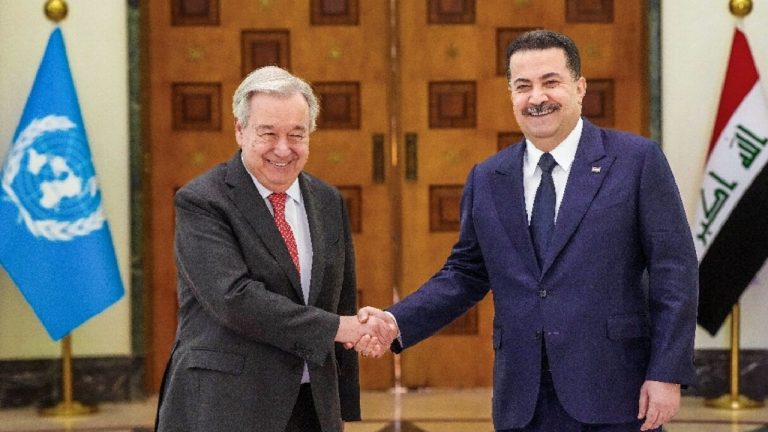
UN Secretary-General António Guterres’s December visits to Saudi Arabia, Oman and Iraq—culminating in UNAMI’s formal closure after 22 years—signal potential shift from external crisis management toward regional diplomatic leadership. This trajectory challenges Samuel Huntington’s “clash of civilizations” framework by demonstrating how states sharing cultural heritage leverage proximity and understanding to mediate conflicts that paralyzed international institutions.
Iraq Transition Demonstrates Capacity for Sovereign Governance
UNAMI concluded operations December 31, 2025, following Iraqi Prime Minister Mohammed Shia al-Sudani’s May 2024 request citing “political and security stability” achievements justifying mission termination. Security Council Resolution 2732 unanimously accepted this assessment, authorizing transition planning for mandate ending after supporting Iraq through Saddam Hussein’s overthrow, sectarian violence, and Islamic State occupation.
Guterres praised “courage, fortitude and determination of Iraqi people” while stating “Iraq is now normal country, and relations between UN and Iraq will become normal relations.” Baghdad honored UN contributions by dedicating “United Nations Street” commemorating 22 staff killed in August 2003 Canal Hotel bombing, including Special Representative Sérgio Vieira de Mello.
Iraqi Foreign Minister Fuad Hussein characterized mission conclusion as demonstrating “ability to manage national affairs and strengthen sovereignty and constitutional institutions.” Yet Iraqi specialists warn the decision creates “humanitarian and political vacuum,” arguing termination reflected public pressure rather than institutional readiness assessment.
UNAMI supported judicial reforms, promoted human rights, coordinated ISIS response protecting millions of displaced persons, and facilitated inclusive political dialogue. At least 2.2 million Iraqis were displaced fleeing Islamic State offensive, with many Yazidi minority members remaining in camps. Whether Iraq sustains stability without formal UN political mission tests sovereignty claims underlying termination request.
Sudan Crisis Demands Regional Mediation Leadership
Guterres warned “war in Sudan is horrific and must stop” during Middle East visits, as UN describes war-torn Sudan facing “arguably gravest human rights crisis of our time.” The conflict between Sudanese Armed Forces and Rapid Support Forces paramilitary displaced over 12 million people since April 2023—the world’s largest and fastest displacement crisis.
UN documented 3,384 civilian deaths in first half of 2025 alone—nearly 80% of entire 2024 casualties. At least 21.2 million people face acute food insecurity, with 638,000 experiencing catastrophic hunger. Over 150,000 people have been killed through violence, starvation and disease since conflict began, while famine was confirmed in five North Darfur locations.
UN Human Rights Chief Volker Türk characterized Sudan as “forgotten conflict” where atrocity crimes including war crimes are committed. Both SAF and RSF obstruct humanitarian access, with RSF using sexual violence as weapon of war while SAF imposes arbitrary bureaucratic restrictions hampering aid delivery.
Regional powers possess geographic proximity and cultural understanding that Western institutions lack for effective mediation. Saudi Arabia and Oman demonstrated diplomatic capacity addressing Yemen’s Houthi conflict, yet Sudan’s escalating crisis requires expanded engagement translating regional influence into concrete peacemaking results.
Oman’s Mediation Model Demonstrates Quiet Diplomacy Effectiveness
Guterres thanked Sultan Haitham bin Tarik for “constructive and balanced foreign policy” promoting dialogue and diplomatic solutions regionally and globally. Oman mediated May de-escalation agreement between United States and Yemen’s Houthi movement while negotiating with Houthis over UN staff release held by rebels.
Harvard International Review characterized Oman as “Switzerland of Middle East” recognizing mediation efforts internationally acknowledged during 2015 Iran nuclear deal negotiations. This diplomatic capital derives from sustained neutrality, relationships across ideological divides, and preference for confidential negotiations over public confrontation.
Yemen conflict escalated since early December, requiring renewed mediation intervention. Regional states understanding Yemen’s tribal dynamics, sectarian complexities and external sponsor motivations possess advantages that distant international actors cannot replicate. Oman’s model demonstrates how regional powers leverage cultural proximity and sustained relationships for conflict resolution where formal multilateral frameworks stalled.
Civilizational Peace Framework as Strategic Reorientation
Huntington’s 1996 thesis argued post-Cold War conflicts would emerge along civilizational fault lines defined by cultural and religious identities rather than ideological or economic divisions. The framework allocated Middle East to “Islamic civilization” characterized by shared Islamic heritage influencing social and political processes across region.
Yet Huntington’s model predicted confrontation—”clash”—rather than cooperation among civilizations. Current regional dynamics suggest alternative trajectory: states within shared civilizational space leveraging cultural understanding for conflict mediation rather than allowing differences to escalate into confrontation.
Iraq experienced catastrophic violence throughout eight decades including Arab-Israeli conflict, Yemen civil war, Lebanese civil war, Iran-Iraq war, Gulf war, Lebanon war, Syrian civil war, and 2003-2011 Iraq war. This accumulated trauma creates both urgency for peace and credibility for regional actors understanding conflict’s human costs.
The civilizational peace framework proposes regional powers familiar with dynamics become strategic players finding conflict solutions. Saudi Arabia, Iraq and Oman benefit foreign policies by bringing peace to shared Islamic civilization sphere—not through cultural superiority claims but through proximity-enabled understanding and mediation capacity.
Rather than “clashing” with Western, Sinic, Hindu-Buddhist, Orthodox, Latin American or sub-Saharan African civilizations, regional players collaborate with international community under UN agenda solving conflicts. This occurs through state-level mediation or individually through bringing regional representatives to global positions enabling peacemaking authority.
Implementation Challenges Beyond Conceptual Framework
Translating civilizational peace theory into operational diplomacy encounters substantial obstacles. Regional powers pursuing mediation face domestic political constraints, competing strategic interests, and limited material resources for sustained engagement. Saudi Arabia balances Yemen involvement against Iran competition and economic diversification priorities. Oman’s neutrality requires careful navigation avoiding alignment that would compromise mediation credibility.
Iraq’s claimed governance capacity following UNAMI closure remains untested during crisis. Whether Baghdad possesses institutional strength for regional peacemaking while managing internal sectarian tensions, corruption challenges and reconstruction demands is unclear. Former Iraqi President Barham Salih’s nomination as UNHCR head—first Middle East nominee in half century—provides symbolic recognition yet doesn’t resolve structural mediation capacity gaps.
Sudan demonstrates regional mediation limitations. Despite geographic proximity and cultural connections, neither Saudi Arabia nor Oman achieved conflict termination despite apparent advantages over distant international actors. Warring parties receive external support from UAE and other actors undermining mediation efforts. Regional powers lack enforcement mechanisms compelling compliance when parties prefer military solutions.
The civilizational peace framework offers compelling alternative to conflict-focused paradigms yet requires demonstrating sustained mediation success translating proximity and understanding into measurable violence reduction and political settlement achievement. Current evidence shows promise through individual initiatives—Oman’s Yemen mediation, Iraq’s stability claims—yet comprehensive validation remains aspirational rather than established.
Original analysis inspired by Dr. Diana Galeeva from Arab News. Additional research and verification conducted through multiple sources.