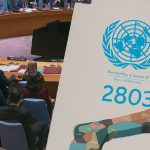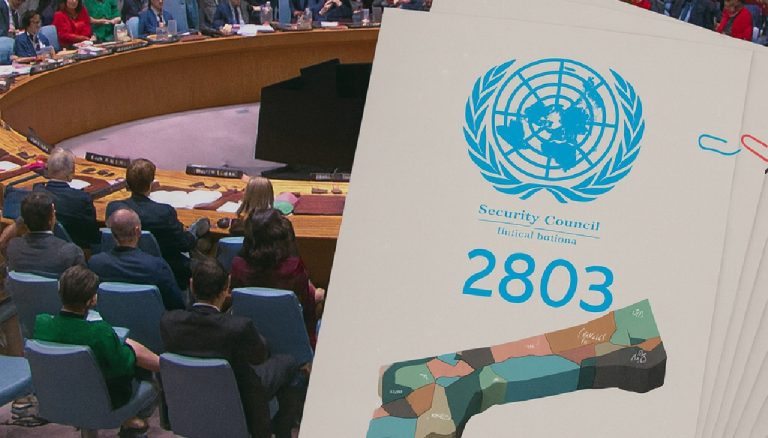
UN Security Council Resolution 2803 passed November 17, 2025 endorsing Trump’s Gaza peace plan creates unprecedented governance framework: a U.S.-chaired Board of Peace functioning as transitional administration alongside International Stabilization Force authorized to “use all necessary measures.” Yet this architecture arrives following UN Commission of Inquiry findings that Israel committed four genocide acts against Palestinians—creating potentially explosive contradiction between post-genocide stabilization and accountability imperatives.
Board Structure Concentrates Authority Without Palestinian Representation
The resolution welcomes Trump-chaired Board of Peace as “transitional administration with international legal personality” empowered to coordinate funding and set Gaza’s development framework until Palestinian Authority completes undefined reform program. Trump declared the board will include “the most powerful and respected Leaders throughout the World,” with former UK Prime Minister Tony Blair the sole named member beyond Trump himself.
Palestinian involvement remains marginal. Resolution language “allows for” establishment of Palestinian executive committee handling day-to-day administration—not mandates. This committee comprises “qualified Palestinians and international experts,” subordinated to Board supervision rather than functioning as primary governing authority. Chatham House analysts note the Board operates with autonomy that challenges Charter principles, as it’s neither UN subsidiary organ nor accountable to Secretary-General.
Chinese Ambassador Fu Cong stated the resolution “outlines post-war governance arrangements for Gaza, but it seems Palestine is barely visible in it,” while Palestinian sovereignty and ownership aren’t fully reflected. Russian Ambassador Vasily Nebenzya warned the arrangement gives “complete control over the Gaza Strip to the Board of Peace,” whose modalities remain undefined—characteristics he characterized as “reminiscent of colonial practices.”
This hierarchy mirrors historical patterns: external powers design security arrangements while Palestinian self-rule becomes perpetually deferred “pathway.” ASIL legal scholars note the framework differs critically from UN missions in East Timor and Kosovo, which operated following referendums providing clear self-determination expressions and functioned as subsidiary organs answerable to Security Council.
Genocide Findings Create Accountability Contradictions
The September 2025 UN Commission of Inquiry concluded that Israeli authorities committed four genocide acts: killing members of the group, causing serious bodily/mental harm, deliberately inflicting destructive conditions of life, and imposing birth-prevention measures. Commission Chair Navi Pillay stated “responsibility for these atrocity crimes lies with Israeli authorities at the highest echelons.”
The Commission urged states to “employ all means reasonably available to them to prevent the commission of genocide” and “cease the transfer of arms and other equipment to Israel where there is reason to suspect their use in military operations that have involved or could involve the commission of genocide.” Yet Resolution 2803 mandates ISF coordination with Israel on borders and security without requiring cooperation with Commission investigations or International Criminal Court proceedings.
This creates fundamental tension: Washington leads stabilization mission while potentially continuing policies the Commission identified as enabling genocide. Commission recommendations specify states must “ensure individuals and corporations in their territories are not involved in the commission of genocide” and “facilitate investigations and domestic proceedings”—obligations Resolution 2803 doesn’t address.
Pillay emphasized that “when clear signs and evidence of genocide emerge, the absence of action to stop it amounts to complicity.” Deploying American-led forces without genocide-prevention safeguards risks positioning Washington as managing genocide aftermath while leaving enabling structures intact—exposing U.S. to accusations of complicity rather than accountability.
Israeli Withdrawal Terms Remain Vague While Demilitarization Proceeds
Resolution 2803 conditions complete Israeli withdrawal on undefined benchmarks met in Gaza. Chatham House analysis notes “timing for complete Israeli withdrawal is yet to be agreed, and is subject to unclear conditions” while Board of Peace and ISF support humanitarian deliveries without specific requirements directed at Israel regarding access facilitation.
The ISF mandates include “stabilizing security environment, supporting demilitarization of Gaza, dismantling terrorist infrastructure, decommissioning weapons and maintaining safety of Palestinian civilians” with authorization to coordinate with Egypt and Israel. Yet demilitarization demands precede political horizon establishment—requiring Palestinian armed groups disarm into continued statelessness without guaranteed path toward self-determination.
Historical precedent suggests front-loaded demilitarization without enforceable political guarantees generates resistance rather than stability. Trump’s plan states “after PA reform program is faithfully carried out and Gaza redevelopment has advanced, conditions may finally be in place for credible pathway to Palestinian self-determination”—language making sovereignty perpetually conditional on external validation rather than Palestinian choice.
Israeli Ambassador Danny Danon emphasized “demilitarization of Hamas is basic condition” while several Israeli officials clarified there will not be Palestinian state despite resolution references to potential statehood pathway. This disconnect between stated framework and implementation reality suggests Resolution 2803 risks functioning as diplomatic cover for permanent control arrangements rather than genuine transition.
Two-Year Mandate Without Enforceable Exit Strategy
Board of Peace and ISF mandates expire end of 2027 unless renewed. Extension requires only new Security Council vote without specified Palestinian consent mechanisms—enabling indefinite prolongation if mission “succeeds” at stabilization without resolving underlying occupation. U.S. Ambassador Mike Waltz characterized Resolution 2803 as charting “new course for Middle East,” yet no benchmarks link progress to specific Israeli withdrawal timelines or settlement expansion halts.
Resolution language on Palestinian statehood remains deliberately conditional. It states conditions “may finally be in place for credible pathway” after reforms and reconstruction rather than establishing pathway as mission objective. Australian analysts note Netanyahu government opposes two-state solution, committed to Greater Israel comprising all Palestinian territories—making resolution’s statehood references aspirational rather than operational.
Without tying mandate renewal to measurable Palestinian sovereignty advances—including lifting movement restrictions, reopening crossings, restoring due process and ending settlement expansion—Resolution 2803 risks institutionalizing “interim” arrangements that become permanent. This transforms temporary stabilization into indefinite international trusteeship managing occupation consequences rather than dismantling occupation structures.
Conclusion: Implementation Determines Legitimacy
Resolution 2803 creates narrow opening for stabilization following devastating conflict. Yet the 13-0 vote with Russia-China abstentions masks fundamental tensions between American-led governance framework and Palestinian self-determination imperatives. Whether implementation follows Oslo patterns—heavy external control, light on rights, perpetually deferred sovereignty—or charts genuine transition depends on choices Washington makes in Board statutes, ISF rules of engagement, and operational guidance.
Palestinian Authority welcomed resolution stating readiness to participate in implementation. Algerian Ambassador acknowledged Trump’s peace efforts while stressing “genuine peace in Middle East cannot be achieved without justice for Palestinian people who have waited decades” for independent state. This captures essential tension: stabilization without justice becomes containment, not resolution.
For Washington, embedding genocide-prevention safeguards, allocating meaningful Palestinian representation within Board of Peace, and linking mission extension to sovereignty benchmarks rather than security metrics alone represents difference between temporary stabilization enabling exit versus indefinite trusteeship cementing American military entanglement. Current framework leans toward latter—risking quagmire precisely when administration claims seeking Middle East disengagement.
Original analysis inspired by Carol Daniel-Kasbari from Quincy Institute. Additional research and verification conducted through multiple sources.