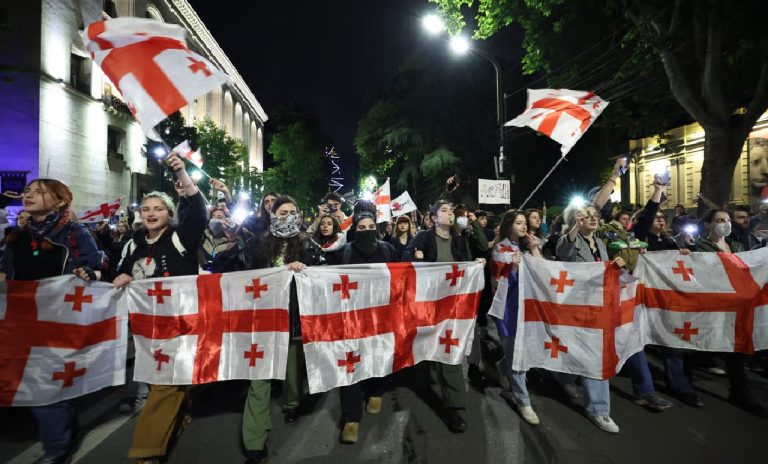
Georgia’s ruling party has transformed from nominal Western partner into systematic antagonist through deliberately borrowed rhetoric. Georgian Dream now routinely deploys “Deep State” and “Global War Party” terminology to discredit European and American diplomats while positioning itself as defender of sovereignty against foreign manipulation—a strategy serving domestic consolidation while enabling geopolitical hedging toward Moscow and Beijing.
Conspiratorial Vocabulary Replaces Partnership Framework
Prime Minister Irakli Kobakhidze claimed in October that “the U.S. State Department better prove that it acts not under the influence of the ‘Deep State’ but in accordance with the objective interests of the American people,” characterizing Washington’s diplomatic establishment as shadowy network pursuing regime change. This represents dramatic evolution from Soviet-era anti-American clichés toward vocabulary directly imported from contemporary Western domestic politics.
Georgian Dream’s political lexicon now systematically portrays U.S. administration, State Department, Congress, European Parliament and diplomatic corps as unified hostile machine operating beyond democratic control. The party designates anyone advocating Georgia’s Western orientation as foreign agents recruited to destroy “traditional way of life”—including former presidents, prime ministers, foreign ministers and civil society organizations.
State Security Service Chairman Mamuka Mdinaradze accused the U.S. Embassy in Bangkok of funding “radicals acting against the government and pursuing revolutionary goals,” while claiming American taxpayer money finances domestic unrest. These accusations from NATO aspirant seeking EU membership demonstrate calculated strategy rather than rhetorical excess.
The terminology serves multiple functions simultaneously. It deflects responsibility for democratic backsliding onto external actors while inoculating Georgian Dream against Western criticism by mimicking American political discourse. When officials use language with origins in the United States to attack Washington, they undermine moral authority Western institutions traditionally wielded in post-Soviet space.
Diplomatic Relations Deteriorate Through Personal Attacks
Berlin recalled Ambassador Peter Fischer in October 2025 after sustained Georgian government attacks, including Kobakhidze’s comparison of European statements to “Goebbels-style propaganda”—invoking Nazi Germany’s propaganda minister as metaphor for contemporary EU institutions. Germany’s Foreign Ministry stated Georgian leadership had “for months been agitating against the EU, Germany and the German ambassador personally.”
U.S. ambassadors face similar systematic attacks. Kobakhidze accused Ambassador Kelly Degnan in 2022 of “demanding Georgia open a second front against Russia,” establishing pattern continued against current Ambassador Robin Dunnigan. Kobakhidze stated bluntly: “The Americans, their bureaucracy, viewed us as an enemy. The ambassador on the ground did this.”
Most extraordinarily, Kobakhidze accused EU Commissioner Oliver Varhelyi of threatening him with physical violence, alleging Varhelyi suggested he could face fate similar to Slovak Prime Minister Robert Fico’s May assassination attempt. These accusations transform diplomatic disagreements into conspiracy theories about Western-orchestrated violence.
The pattern reveals deliberate strategy. Each Western condemnation generates Georgian broadside, which pro-government media celebrates as sovereignty assertion. Washington’s restrained responses follow predictable cycle—U.S. statements generate ridicule, domestic audiences applaud defiance, and Georgian Dream claims victory over “Deep State.”
War Rhetoric Reframes Western Integration as Existential Threat
Georgian Dream’s “Global War Party” narrative portrays American military-industrial complex, George Soros, neoconservatives and European bureaucrats as conspiring to open second front in Georgia using U.S. Ambassador as operational leader. Kobakhidze stated: “As long as the war continues in Ukraine, the Deep State has vested interest in opening second front in Georgia.”
This framing transforms every Western criticism into war threat. “Do you want war?” becomes defining political question for society traumatized by Russia’s 2008 invasion and ongoing occupation of Abkhazia and Tskhinvali. Georgian Dream presents itself as sole bulwark against renewed conflict while portraying NATO and EU integration as destabilizing provocations rather than security guarantees.
The party sent open letter to Trump campaign congratulating them for “eradicating the Deep State,” which Ambassador Dunnigan described as “insulting, unserious, and extremely poorly received in Washington.” Yet domestically the letter signaled Georgian Dream’s supposed alignment with Trump administration against shared enemies.
Following Trump’s inauguration, Georgian Dream officials expressed disappointment that Washington continued criticizing Tbilisi. Tbilisi Mayor Kakha Kaladze stated: “I expected that when the Trump administration came, it would thank the Georgian government” for identifying “Deep State” threats before American officials acknowledged them.
This reveals fundamental miscalculation. Georgian Dream believed shared conservative rhetoric would override policy disagreements about democratic backsliding. Carnegie Endowment analysts note Georgian Dream convinced voters that Western rapprochement was merely “postponed until more ‘reasonable’ forces” returned to power—making Trump’s lack of engagement particularly destabilizing for ruling party narratives.
Strategic Functions Beyond Emotional Outburst
Anti-Western rhetoric serves calculated purposes. First, domestic consolidation: blaming “Deep State” for isolation deflects responsibility for corruption while portraying Georgian Dream as sovereignty defender. The party passed Foreign Agent Law and LGBT Propaganda Bill using Western interference narratives to justify repressive legislation.
Second, geopolitical hedging: antagonizing West while increasing trade with Russia to $1.9 billion through nine months of 2025 signals to all sides that Tbilisi remains too unpredictable to punish severely. Third, narrative capture: mimicking American political language attempts undermining Western moral authority by turning democratic discourse against democratic institutions.
Digital Forensic Research Lab documented suspicious websites amplifying Russian state narratives targeting Georgia with claims about Western-instigated coups and foreign interference. This disinformation ecosystem supports Georgian Dream messaging while providing plausible deniability about coordination with sanctioned Russian entities.
The absurdity reaches heights because Georgia’s survival depends on Western security guarantees against Russian threat. Georgian Dream testified before U.S. Congress in September 2025 as case study in democratic backsliding—transforming from “beacon of democracy” to “anti-American government” within decade.
Performative Dependency as Political Strategy
Georgian Dream understands asymmetry: Russia poses legitimate military threat while West responds to insults with diplomatic statements rather than consequences. This makes Western institutions convenient scapegoats while Moscow’s occupation of Georgian territory requires careful management. Georgian Dream maintains it safeguards “stability” while Western “deep state” seeks dragging Georgia into Ukraine conflict with opposition party assistance.
Brussels effectively froze Georgia’s EU accession bid following disputed 2024 parliamentary elections, yet Georgian Dream celebrates Western criticism as independence proof. Resentment has become political capital, parody transformed into policy, and borrowed American rhetoric weaponized against its originators.
The pattern extends beyond Georgia. Illiberal leaders globally learned using Western language to delegitimize criticism while maintaining business and defense relationships. Georgia’s case proves especially instructive because dependence on Western security guarantees makes rhetorical attacks simultaneously reckless and calculated—insulting partners who cannot afford complete disengagement creates space for authoritarian consolidation without triggering decisive consequences.
Whether Georgian Dream’s gambit succeeds depends partly on Western response coordination and partly on domestic population’s continued pro-Western orientation despite government propaganda. For now, Tbilisi has discovered that ridicule remains cheapest form of provocation when targets prioritize stability over accountability.
Original analysis inspired by Jamestown Foundation research. Additional verification conducted through multiple sources.
Tags: Georgia, United States, European Union, Jamestown Foundation, Georgian Dream, Democratic Backsliding, South Caucasus
Categories: Georgian Politics | US-Georgia Relations | EU Relations | Democratic Backsliding | South Caucasus | Authoritarian Trends