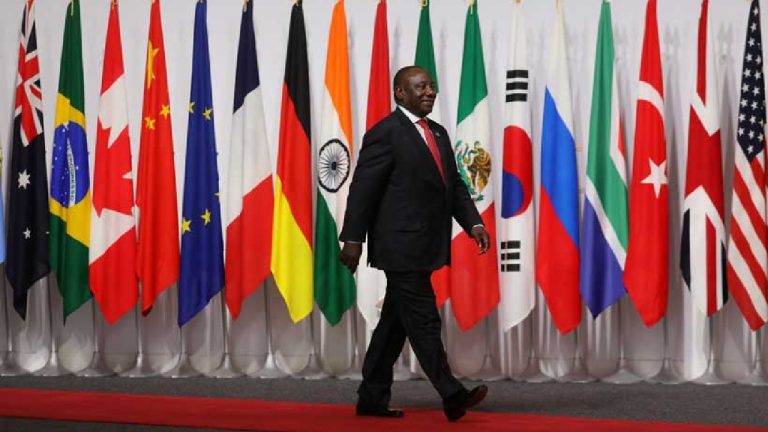
Africa’s September 2023 elevation to permanent G20 membership marked symbolic culmination of gradual engagement evolution since 2008 financial crisis. Yet transforming high-level commitments into measurable development outcomes requires addressing systematic implementation shortfalls that have characterized G20-Africa partnerships throughout the first cycle—particularly financing gaps, coordination challenges, and accountability deficits.
From Ad Hoc Crisis Response to Structured Partnership Framework
Post-2008 financial crisis interventions initially treated Africa as passive recipient of stabilization efforts rather than strategic partner. Early G20 communiqués acknowledged developing world vulnerabilities without establishing systematic engagement mechanisms. South Africa remained the only Black-majority permanent member until India’s 2023 presidency championed African Union admission—transforming representation from single country to continental bloc with 55 member states and 1.4 billion population.
Indian Prime Minister Narendra Modi announced permanent membership at the New Delhi summit’s opening, stating “it was in the spirit of ‘Sabka Saath’ that India proposed permanent membership for the African Union.” The AU became only the second regional organization alongside the European Union to achieve this status, representing approximately $3 trillion combined GDP.
This institutional evolution reflected accumulated pressure from African leadership and international supporters. President Joe Biden publicly advocated AU membership during 2022 U.S.-Africa Summit, signaling bipartisan recognition that excluding Africa from global economic governance undermined both legitimacy and effectiveness. AU Chairman Moussa Faki Mahamat characterized membership as “propitious framework for amplifying advocacy in favor of the Continent” on global challenges.
Compact with Africa Shows Mixed Results Despite Reform Focus
Germany’s 2017 presidency launched the Compact with Africa initiative targeting private investment through macroeconomic, business and financing framework improvements. Fourteen African nations now participate—Benin, Burkina Faso, Côte d’Ivoire, DRC, Egypt, Ethiopia, Ghana, Guinea, Morocco, Rwanda, Senegal, Togo, Tunisia and Zambia—with commitments monitored semi-annually through G20 Africa Advisory Group coordination.
Recent IMF working papers acknowledging they “could not establish causal link between participation in CWA and FDI inflows” despite preliminary positive indicators. Results point to positive effect but estimated impact remains statistically insignificant—potentially reflecting implementation timelines insufficient for demonstrating macroeconomic reform effects.
One analysis using synthetic difference-in-differences methodology suggested CwA induced approximately 5 percentage point increase in GDP per capita growth rates during 2017-2021, driven by exports, public consumption and FDI inflows. Yet researchers emphasize caution given selection biases favoring countries with pre-existing stronger institutions, better infrastructure and superior human development.
South African Finance Minister Enoch Godongwana claimed the initiative mobilized $191 million in private investment—modest compared to Africa’s infrastructure financing gap estimated at hundreds of billions annually. Germany’s Chancellor Friedrich Merz announced €3.2 billion financial package at recent summit, while G20 leaders endorsed second phase (2025-2033) backed by new World Bank multi-donor fund.
Implementation Gaps Undermine Commitment Credibility
Systematic analysis reveals persistent disconnects between G20 declarations and operational delivery. Climate finance exemplifies this pattern: wealthy nations repeatedly commit to mobilizing hundreds of billions for developing country adaptation and mitigation yet actual disbursements fall substantially short while administrative burdens limit access. African countries face developmental challenges including poverty, inequality and unemployment alongside climate commitments despite minimal historical emissions responsibility.
Food security initiatives similarly demonstrate commitment-delivery gaps. Multiple G20 summits proclaimed addressing African agricultural productivity and market access, yet protectionist trade policies from major economies continue undermining African exports while dumping subsidized agricultural products damages local producers. Digital transformation commitments encounter infrastructure financing shortfalls preventing meaningful connectivity expansion.
Critics identify structural problems within Compact framework itself. GIGA Hamburg analysts argue the initiative remains “incomplete” without closer linkage to country development strategies based on 2030 Agenda and Africa’s Agenda 2063. Education investment receives insufficient attention despite its centrality to sustainable development, while G20 members avoid committing to predictable trade regimes for Compact economies.
Coordination challenges plague implementation. Multiple bilateral initiatives, multilateral programs and private sector engagements operate without systematic alignment, creating duplication while leaving priority gaps unaddressed. Monitoring mechanisms lack enforcement authority, reducing commitments to aspirational targets without accountability for non-delivery.
Second Cycle Must Prioritize African Leadership and Accountability
AU permanent membership creates institutional foundation for more substantive engagement provided G20 presidency cycles maintain focus beyond symbolic gestures. The critical test involves whether upcoming presidencies systematically align G20 initiatives with Africa’s own development agenda—specifically Agenda 2063’s strategic framework for socioeconomic transformation.
This requires moving beyond donor-recipient dynamics toward genuine partnership based on mutual accountability. African governments must demonstrate reform implementation and transparency about resource utilization. G20 members must fulfill financing commitments, reduce market access barriers, and support technology transfer enabling African industrialization rather than perpetuating raw material extraction models.
Wilson Center analysts note AU membership could draw G20 into security issues beyond its primary economic focus, while tensions between poorest nations and economic powers like South Africa, Ethiopia, Nigeria and Kenya complicate consensus-building. Successfully navigating these challenges requires AU demonstrating unified positions respecting all member views despite individual state status variations.
Climate finance, food security, digital transformation and institutional capacity-building represent priority areas where deeper cooperation could yield transformative impacts. Yet success depends on mechanisms ensuring commitments translate into sustained resource flows rather than remaining declaratory statements revised at subsequent summits without consequences for failures.
The evolution from ad hoc post-crisis initiatives toward structured partnership culminating in permanent membership demonstrates progress. Whether this institutional foundation enables substantive development acceleration or merely formalizes consultation without implementation remains the defining question for G20-Africa relations’ second cycle.
Original analysis inspired by Margaux Giannaros and Krissmonne Olwagen from South African Institute of International Affairs. Additional research and verification conducted through multiple sources.
Tags: Africa, G20, African Union, SAIIA, Compact with Africa, Development Policy, Global Governance
Categories: African Development | Global Economic Governance | G20 Policy | International Development | AU-G20 Relations | Development Finance